Showing posts with label biodiversity heritage library. Show all posts

Tuesday, 5 March 2013

Spode & Curtis

Cyclamen coum on plate and paper (below)
Thanks to Val Bott for bringing the following to my attention.  Its always interesting to see how different art forms influence each other, in this case botanical illustration on porcelain decoration.  


The post by Pam Woolliscroft author of Spode History tells about the botanical designs employed by Spode in the 19th century and which were inspired by the plates in Curtis's Botanical Magazine.  The magazine was founded by William Curtis in 1787.  Samuel  succeeded to the editorship of the magazine in 1827 selling his rights in 1846. Curtis's Botanical Magazine (1801-1920) is downloadable for free from our good friends at the Biodiversity Heritage Library.

Spode is a Stoke-on-Trent based pottery company that was founded by Josiah Spode (1733-1797) in 1770. Josiah Spode earned renown for perfecting under-glaze blue transfer printing in 1783-1784 – a development that led to the launch in 1816 of Spode’s Blue Italian range which has remained in production ever since.  Josiah Spode is also often credited with developing a successful formula for fine bone china.

A snip at €2,413
A modern example of the same would be Royal Copenhagen's beautiful - but expensive - Flora Danica collection.


Friday, 22 February 2013

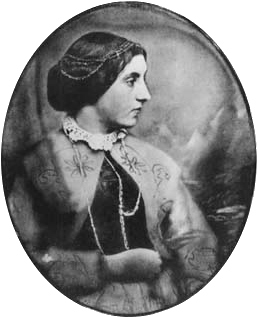
Jane Loudon

Jane Loudon 1807-1858
Garden historians are generally familiar with the hugely prolific, workaholic 19th century garden designer and garden-writer, John Claudius Loudon.  Most of his works are available from the Biodiversity Heritage Library for free - just follow this link.

However, he was married to an equally fascinating woman, Jane Loudon (née Webb).  Jane was not only a pioneer of science fiction (The Mummy! was published in 1827) but also a pioneer in encouraging ladies to garden - genteelly of course! 


Jane was the author of five books and one magazine and her highly popular and influential Instruction on Gardening for Ladies (1840) has been reprinted by Oxford University Press and both the tome and the author as the subject of yet another fascinating post from the Cambridge Library Collection.

Do take a read and learn more about Mrs. Loudon


Tuesday, 19 February 2013

Gardening for the Disabled

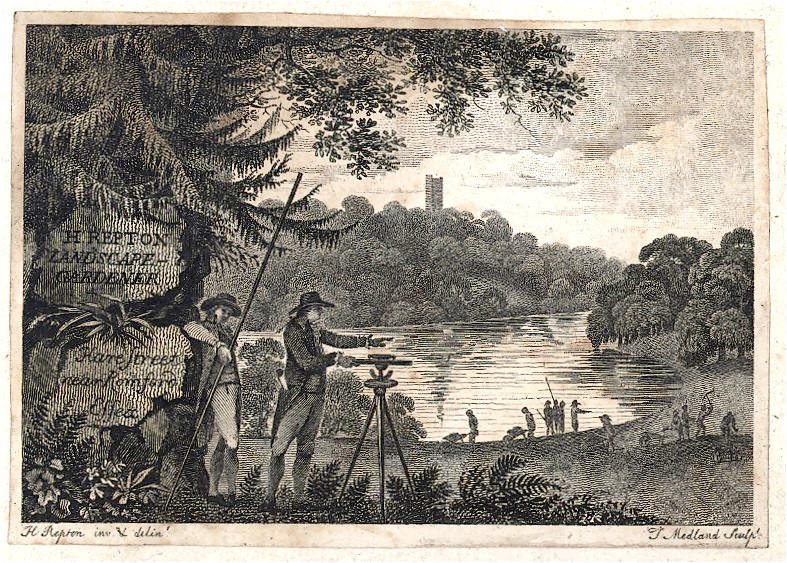
Repton's business card
An interesting post, as always, from GardenHistoryGirl that examines the work of Humphry (it is spelt without an 'e') Repton who was the first to write about gardening for the disabled.

As the result of a coach crash Repton used a wheelchair for the last two years of his life and was likely the inventor of the raised bed which allowed those so confined to garden.  He even illustrated the concept in his Fragments on the theory and practice of landscape gardening (1818). 


And just for reference, many of Repton's books are available for free as pdfs from those great folk at the Biodiversity Heritage Library (the link is to the Repton page).

Friday, 14 December 2012

Biodiversity Heritage Library Images Follow-up


Thanks for your comment Anonymous, and I have been Tweeting with the folks at the Biodiversity Heritage Library  () on exactly that.  The topic of plant names that correspond with the images in their photostream.

In some cases there is no problem, the plant is named on the plate, for example Hooker's rhododendrons. 


But in the case of Curtis's Botanical Magazine, for instance each plate has a number and each volume an Index that links plate  numbers to plant names

I suggested to the BHL that they put the plant name in the image file name, but can see that this would be too labour intensive.

The BHL replied asking that we users help by 'machine tagging' the images. 
  
The link is in blue
In the bottom left corner of every image there is a link that takes you to the image in its volume on the BHL website, and the next page in the text has the plant name/description.

I then asked the BHL, for the Curtis's volumes at least, to include in each photoset an image of the Index which would make it far easier and quicker for volunteers to help machine tag the plants.  We will wait and see what happens.

Thursday, 13 December 2012

The Biodiversity Heritage Library does it again


I am a huge fan of the Biodiversity Heritage Library.  It is simply a fantastic resource for accessing old monographs and periodicals for free and without the hassle of having to travel to libraries.  You simply download the required tome / volume as a pdf - and to top it all, its FREE.


Now the BHL is offering another wonderful resource - the BioDivLibrary photostream of scanned plates of, for the purposes of this blog, flowering plants. The collection of images is ever increasing, but already there is a folder of plates from Curtis's Botanical Magazine and Walter Fitch's lovely rhododendrons from Joseph Hooker's The rhododendrons of Sikkim-Himalaya. 


But, of course, the site holds much more than just flowering plants.  So do take a look and make use of this superb resource.

Thursday, 30 August 2012

A Lost Garden in Jersey - and Samuel Curtis

Image from Samuel Curtis Garden Project

A post on the Garden History Society Forum tells that sadly the garden of Chateau la Chaire (now is Chateau La Chaire hotel and restaurant) is 'destined to remain lost since the failure to kick start the renaissance of this once sublime sub-tropical plants mans paradise at Rozel Bay, on the Sunshine Island of Jersey.'

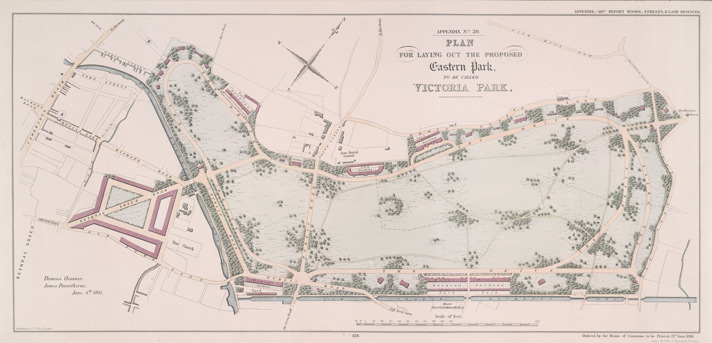
The garden was designed in from 1841 by the English nurseryman, publisher and botanist Samuel Curtis. Curtis who designed Victoria Park in Bethnal Green from 1845.  The park is being used as part of the 2012 London Olympics to host BT London Live Victoria Park.

1845 Plan for Victoria Park
Curtis eventually moved into the chateau in 1852There is a goodly correspond between Curtis and  Sir William Hooker (who was Director) at Kew, and  Outbooks reveal that Curtis received many new, exotic and slightly tender plants which had arrived at Kew through the endeavours of the plant hunters and which Kew dispatched in order to trial them in Curtis's new garden.  There is more about the garden and hoped-for restoration at the Samuel Curtis Garden Project.

You may also recognise Samuel's surname from Curtis's Botanical Magazine, which was founded by Samuel's first cousin and father-in-law, William Curtis in 1787.  Samuel  succeeded to the editorship of the magazine in 1927 selling his rights in 1846. Curtis's Botanical Magazine (1801-1920) is downloadable for free from our good friends at the Biodiversity Heritage Library.

Samuel died at la Chaire in 1860 - and surely there must be a philanthropist or two amongst Jersey's millionaires who would like to help restore Curtis's wonderful creation?
 

Thursday, 26 July 2012

New & Free: The Getty Research Portal™

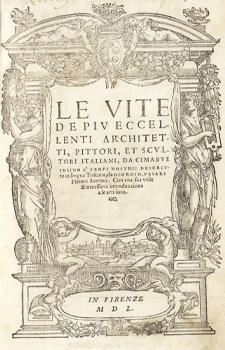
Vite de' più eccellenti pittori, scultori e architetti (Florence, 1550), title page, Giorgio Vasari. The Getty Research Institute, 85-B1482.  View in Portal
For us garden historians, and for that matter, art historians generally, here is a great new and FREE resource.  The Getty Research Portal™is, to quote the homepage, ' an online search platform providing global access to digitized art history texts in the public domain. Through this multilingual, multicultural union catalog, scholars can search and download complete digital copies of publications for the study of art, architecture, material culture, and related fields.'

And dont forget that the Biodiversity Heritage Library also has a huge resource of books and periodicals to download, also for FREE.

Monday, 2 April 2012

17th Century Garden Design For Women

OK, I know the illustration shows men at work!
Should you be looking for an inspiring start to this Monday morning, may I suggest you read Deborah Swift's fascinating post at English Historical Fiction.  It is an introduction to William Lawson's A New Orchard and Garden (1618) which included The Country Housewifes Garden and Swift asserts is 'credited with making gardening popular for women'.  

There is another article on Lawson's tome by the Glasgow University Library and should you wish to read the text the 1626 edition is available from our good friends at the Biodiversity Heritage Library.  

Wednesday, 28 March 2012

More Garden History sources to be Digitised


As you may have realised by now, I am a great fan of the Biodiversity Heritage Library.  And both the organisation and us interested in garden history will welcome the news reported in the St Louis Business Journal that the Missouri Botanic Garden has been awarded a $260,000 grant from the National Endowment for Humanities

To quote the article, the funds will go toward a new project 'titled The Art of Life, (which) will help develop software tools for automated identification and will catalog the visual information contained within more than 100,000 volumes and 38 million pages of core historic literature made available through the Biodiversity Heritage Library.'  

Friday, 9 March 2012

Batty Langley 1696 - 1751

Batty Langley from The Twickenham Museum
I wanted to share with you this interesting blog post on the landscape designer Batty Langley, his work and how it has been used for the restoration of the kitchen and fruit garden at Castle Bromwich.

Plan for a Serpentine Garden from New Principles
And, of course, those good folk at the Biodiversity Heritage Library can supply you with a free copy of Langley's New principles of gardening (1728). 

Monday, 9 January 2012

Early Plant Introductions - Gerard's Forgotten Gem

A few posts ago I introduced the first written records of plants in British gardens - and it has generated some interest.  So in this vein, the Book of the Week this week is a tome by John Gerard (1545-1611/12).  
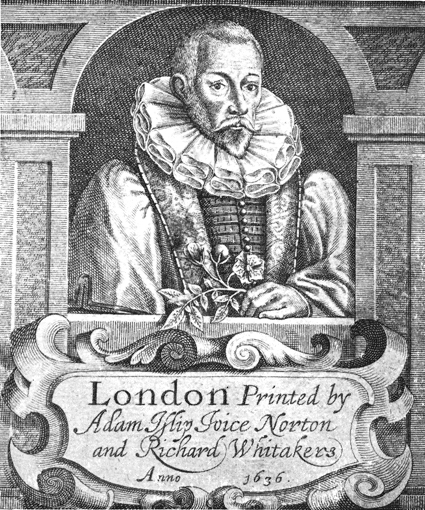
John Gerard from the 1636 ed. of The Herball
And no, its not the book he is most famous for, The Herball or generall historie of plantes  which first appeared in 1597 and was posthumously enlarged and reprinted in 1636 - click the date for the different editions from the Biodiversity Heritage Library.  In any case The Herball is not an original work, but a translation of Cruydeboeck, the herbal published in 1554 by the Flemish physician and botanist Rembertus Dodonaeus (1517-85).
The Herball (1597)
Gerard was head gardener to that great maker of gardens, Sir William Cecil (1520-1598) -later Lord Burghley and Secretary of State to both Henry VIII and his daughter Elizabeth I (1533-1603.  As such Gerard was one of the most respected horticulturists of his day, and in a position to acquire many rare and unusual plants, both for his master and to plant in his own garden in Holborn, London.

Privately published in 1596 and again in 1599, Gerards snappily-titled Catalogus arborum, fruticum ac plantarum tum indigenarum, quam exoticarum, in horto Johannis Gerardi, civis et chirurgi Londinenais, nascentium (A Catalogue of Plants Dultivated in the Garden of John Gerard) lists the over a thousand types of plants that he cultivated, and includes the first written record of the potato in cultivation.  This very rare volume -  the link is to a 1876 reprint which includes a biography of Gerard - gives a definite date by which many exotic plants both ornamental and edible were in cultivation in England.  Indeed, the publication date is often erroneously quoted as their introduction date.