Showing posts with label taj mahal. Show all posts

Tuesday, 6 March 2012

Jahanara - another lost Mughal garden


In 1648 the fifth Mughal emperor Shah Jahan (famous for building the Taj Mahal - which is now in danger of collapse) moved into his new capital, Shahjahanabad.  Now known as Delhi, it had taken 11 years to build and now replaced Agra as the capitall of the Mughal empire.

According to an excellent article in the Deccan Herald, Jahan's two daughters  'Jahanara and Roshanara, the two princesses, laid out gardens, market squares and serais (rest houses) which were among the most beautiful creations within the new walled city. It was Jahanara, Shah Jahan’s favourite daughter on whom he had conferred the title of Begum Sahib, who had laid out Chandni Chowk, the main market square, and the garden known as Begum ka Bagh.'

The latter, was well recorded by historians and accounts describe the enclosed garden, into which only women and children were allowed, as having 'pools and channels for running water. There were fountains and canopies supported on 12 pillars of red stone (called bara dari). These provided cool resting places for the people who came to the garden. The water in the channels came from a special canal system and helped irrigate the trees and grass and plants within. There were plenty of flowering trees and fruit trees'

Not much peace and tranquility today (image Deccan Herald)
Begum ka Bagh remained a garden for  royal ladies until the reign of Shah Alam II before becoming Company Bagh early during India's rule by the British East India Company. In 1876 it was renamed again to the Queen's Garden following Queen Victoria's elevation to Empress of India.  Sadly, the Begum Samro's Palace which was built in the garden during the reign of Shah Alam II is now one of the main markets for electrical goods in Delhi and of the gardens, the only surviving part is now the Mahatma Gandhi Park.

Saturday, 18 February 2012

Indian Gardens under the Raj

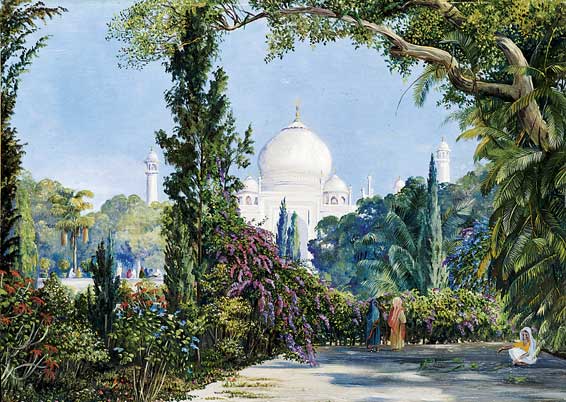
Marianne North's 'The Taj Mahal at Agra. North­ West India' (c.1878)
I seem to keep coming back to the the subject of Islamic and Mughal gardens at the moment.  And here is another strand to the story - but one with a twist.  In today's Financial Times, Robin Lane Fox offers a review of a fascinating sounding new book:  Flora’s Empire by Eugenia W Herbert.


Herbert explores the impact of the British on the gardens of India whilst the country was under their control, explores why the British constructed the gardens in the style that they did, and examines the long term impact of their influence post-Independence.

Friday, 3 February 2012

Gardens of Islam

Another step along our walk through gardening time brings us to the gardens of Islam, a style and form that still is relevant and active today.  But whose origins are over 1,000 old.   As we have seen, garden-making requires a peaceful, stable society.  But with the collapse of the Roman Empire in the 5th century AD, Europe was thrown into turmoil and the conditions favourable to garden making were lost.  The next major garden making influence that swept from Persia across North Africa and into southern Europe was Islam.  

Al-Azhar Park, Cairo
From the Sands
The prophet Muhammad founded Islam in the sands of what is now Saudi Arabia in the 7th century AD.  And in the Qu’ran the faithful are promised that ‘the Garden of Paradise shall be their hospitality, therein to dwell forever’. This garden of Paradise is described at length, and with ‘spreading shade’, ‘fruit and fountains and pomegranates’, and ‘cool pavilions’. 

A Heavenly Paradise
Add to this heady mix, flowers for colour and fragrance, and moving water cool the air, and make a relaxing sound, and to people who inhabited a desiccated and dusty desert land, this truly must have seemed paradise.   

The Generalife, Granada
The Quartered Garden
In Persia, the Muslim conquerors found an established garden making culture, with a garden style that had its origins in the palace garden of Cyrus the Great at Pasargardae.  Made in the 6th century BC, this featured a quadripartite form, that is to say a square divided into to four equal quarters by two water courses running perpendicular to one another.

Plan of the Taj Mahal with its chahar bagh garden
This form had a resonance with Islam and its belief in Jannah (paradise) and the four rivers of life.  So emerged the chahar bagh, which means ‘four gardens (or beds).  At the centre of the chahar bagh is a fountain or source of water which  flows into four rills (narrow canals) that divide the garden into four.  The symbolism of the rills is that they represent the four rivers of life (milk, honey, water and wine).  In the garden itself, the movement of the water would have caught the light and brought a dynamism to the garden. 
Court of Lions, Alhambra
The four beds could be approached in a number of ways - they could simply be paved to create a place to lay cushions and relax.  They could be planted with brightly coloured flowering plants; or they could be sunken beds to give the impression of walking by a carpet of flowers.  The gravel areas in the Court of Lions at the Alhambra were originally sunken beds.  And, as in other religions, many plants have a religious symbolism.

New Garden Forms
As the religion of Islam spread, so did their garden making.  And in all countries that were conquered, the conquering artisans assimilated local traditions.  So today, we have variations on the theme from North Africa to Moorish Spain, from Afghanistan to India - the gardens of the great Mughal Empire, and modern Islamic gardens all over the world, including the Gulf States and Indonesia.
Nishat Bagh, Kashmir
Moreover, the chahar bagh is a an adaptable garden form that allows much ingenuity and adornment, and which can be scaled to fit any space and topography from a tiny, level courtyard in Cairo to an large park that cascades  down a hillside to Lake Dal in Kashmir.

If you want to see an Islamic garden then Spain has the Alhambra in Granada, and the Alaczars in Seville and Cordoba.  There are gardens in Morocco, and, of course the Taj Mahal in India.  A lovely new example is the Al-Azhar Park in Cairo.  See also my earlier post on Persian Gardens.
 

Tuesday, 10 January 2012

A Tragedy unfolding for the Taj Mahal

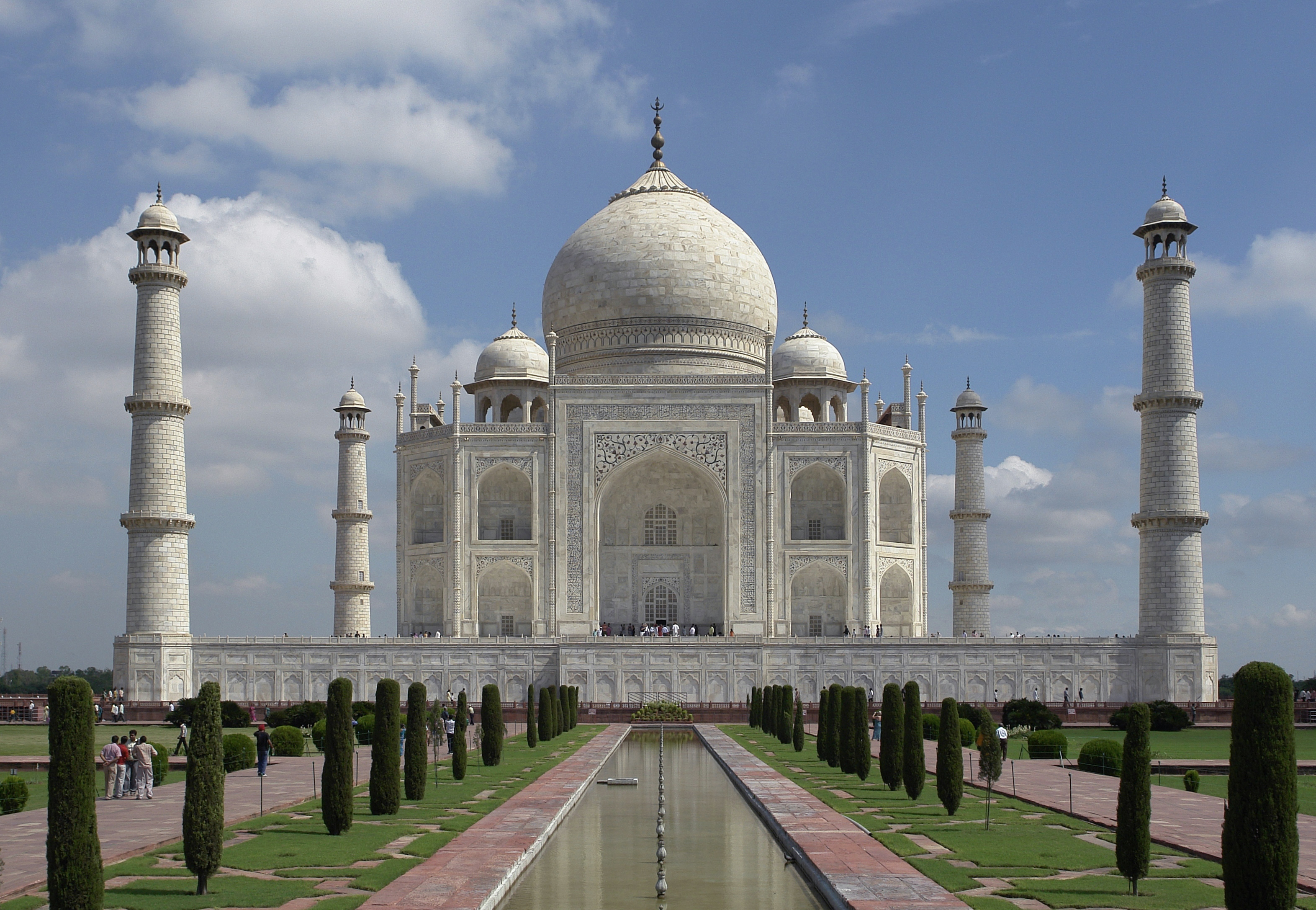
It been quite widely reported that the Taj Mahal in Agra, India and one of the wonders of the world is in danger of collapse within two to five years.  In 2010, cracks appeared in parts of the tomb, and the minarets which surround the monument were showing signs of tilting. The problem is the decline in the water level of the Yamuna River which is dropping at a rate of 1.5m a year causing the wooden foundation of the tomb to rot due to lack of water.

The Taj  has a wonderful example of the chahar bagh form of garden in front of it - but sadly now denuded of the riot of flowers with which it was once filled. 

The Taj also has another garden that few visit.  On the other side of the Yamuna River is the Mahtab Bagh or Moonlight Garden (different links).
An 18th century view showing the chahar bagh in the foreground and the mahtab bagh in the distance.
There is more on the Mahtab Bagh at the start of this episode of Monty Don's 'Around the World in 80 Gardens'.