Showing posts with label mughal. Show all posts

Thursday, 15 March 2012

G is for Gazebo

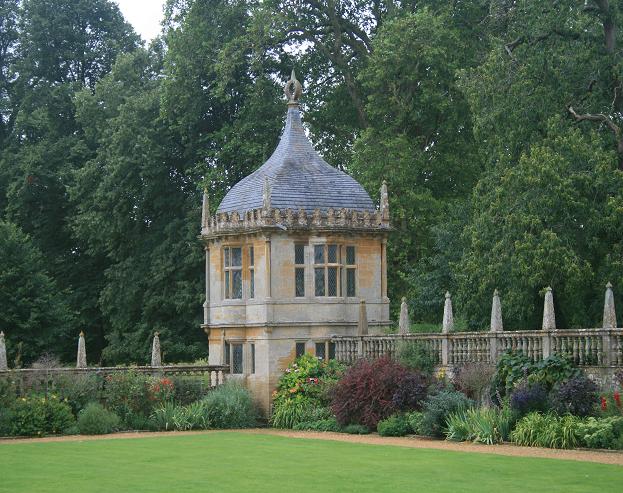
One of a pair of gazebos at Montacute House (attrib. Les Mildon)
The word ‘gazebo’ is a flippant translation from the Latin, ‘I will gaze’, and is used to describe a building or structure from which one may enjoy a view over the garden.   Proper ‘gazing’, required the viewer have an elevated position, and a gazebo came to mean either a small building placed on a natural vantage point or a specially constructed two story stone or brick garden building with a viewing room on the first floor. The gazebo became an especially popular feature in Elizabethan gardens, where the buildings were often built at a corner angle within an enclosed garden in order to command the finest view out over the garden.  This position also meant that the buildings themselves could be admired as a feature in their own right. A twin pair were built in the garden at Montacute House in Somerset.
Henry VIII's Privy Garden at Hampton Court Palace with Mount and Banqueting House
These ornate buildings, which were also used to entertain, trace their origins back through the banqueting houses and wooden structures placed on the top of garden mounts (an innovation of the Tudor garden in 16th century England), to the simple bower, either constructed from trellis or woven saplings, so favoured in the MediƦval garden.  
 
One of the two gazebos at Ram Bagh in Agra that overlook the Jumna River and the garden
Gazebos were also popular in Mughal gardens, where such structures were sometimes built in groups of four, echoing their ancestors, the four dovecotes, one in each the four corners of the quadripartite Persian garden.  

Gazebo in the 'Hanging Garden of Nineveh
Older designed landscapes from the region, for example Mesopotamia such as those made by   the Assyrian kings Sennacherib (r.705-681) at Nineveh (Kuyundjik) and his predecessor Sargon II (r.722-705 BC) at Khorsabad also had garden buildings atop artificial mounts which fit the definition of a gazebos but are often called or pavilions.

Sadly, in an October 2010 report titled Saving Our Vanishing Heritage, named Nineveh was named by the  Global Heritage Fund as one of 12 sites most 'on the verge' of irreparable destruction and loss, citing insufficient management, development pressures and looting as primary causes.

Tuesday, 28 February 2012

Some more information on Ramat Rahel

The blog Historical Gardens has some more interesting facts on the subject of Ramat Rahel, which I introduced in a post last Friday - do take a read.

Saturday, 18 February 2012

Indian Gardens under the Raj

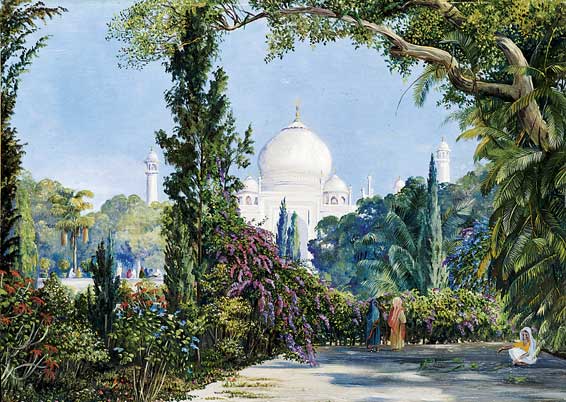
Marianne North's 'The Taj Mahal at Agra. North­ West India' (c.1878)
I seem to keep coming back to the the subject of Islamic and Mughal gardens at the moment.  And here is another strand to the story - but one with a twist.  In today's Financial Times, Robin Lane Fox offers a review of a fascinating sounding new book:  Flora’s Empire by Eugenia W Herbert.


Herbert explores the impact of the British on the gardens of India whilst the country was under their control, explores why the British constructed the gardens in the style that they did, and examines the long term impact of their influence post-Independence.

Thursday, 16 February 2012

C is for Chahar Bagh

OK, OK, I know.  For those of you who have visited the blog before this may seem like a little bit of a repeat of my Gardens of Islam post, but please accept my self-indulgence.  For I simply adore Islamic gardens.  
Babur Supervising the Laying Out of the Garden of Fidelity (Manuscript c. 1590). Walters Art Gallery, Baltimore, Maryland
The words chahar bagh literally mean ‘fourfold garden’ and it is a form that has provided the blue print for the Islamic garden since the 7th century AD - and continues to do so.  However, origins of the quadripartite garden form can be found in the palace garden of Cyrus the Great at Pasargardae (Iran), which dates to the mid-6th century BC.

This quadripartite garden form became popular within Persian gardens and was subsequently assimilated by the Muslim invaders for it fits perfectly with the  ‘Garden of Paradise’ as described at length in the Qua’ran.  At the centre is a fountain or source of water that flows into four rills (narrow canals), which run at right angles and divide the garden into the four beds – hence the name, and which symbolically represent the four rivers of life.  
A small chahar bagh in the cafe of the new Al-Azhar Park, Cairo.
In the earthly expression of the chahar bagh the four beds could be approached in a number of ways:  paved with polished stone laid in patterns the ‘bed’ provide the perfect surface on which to lay carpets and cushions, they can be raised as shown in the  Bagh-e Vafa (Garden of Fidelity), the first garden of the first Mughal Emperor Babur and crated in Afghanistan - see above  Or they can be sunken as was originally the case with the Court of Lions in the Alhambra Palace) to give the impression of walking by a carpet of flowers.  In all cases flower beds were filled with brightly coloured flowering plants.

The Court of Lions in the Alhambra, Grenada in Spain
As Islam spread, so did their garden making, and the conquering artisans assimilated local traditions.  Chahar bagh gardens can be scaled to fit any space from a tiny courtyard to enormous palace complexes, and these gardens can be found from Moorish Spain and North Africa in the west, through the Middle East, Iran and Iraq, to the awesome palaces of Mughal India in the east.  All are different, but all are based on the same core values.  

Friday, 10 February 2012

A VIP Mughal Garden to Visit in Delhi

Image from the President of India website
If you happen to find yourself in New Dehli in the next month then you are in for a treat.  The Hindistani Times reports that starting today and until March 15 there is a wonderful opportunity to visit  the gardens of the  Rashtrapati Bhavan or President's Palace.

As part of the now-controversial development by the British of New Delhi as the new capital,  the palace and gardens were designed from 1912 by Sir Edwin Lutyens to be the residence of the Governor-General.  

Comprising the main garden (above), the terrace garden, the long or purdah garden, and the circular or sunken  garden style, the overall style is an harmonious mix of Mughal and English influences, all stamped with that indelible 'Lutyens-ness'.  The ingenuous mix of geometry, levels and features together with an awareness of space, place and materials that makes his gardens instantly recognisable.

The entry and exit into the gardens is regulated from Gate No. 35 of the President's Estate, which is located near the North Avenue, at the western end of the Church Road. 

Friday, 3 February 2012

Gardens of Islam

Another step along our walk through gardening time brings us to the gardens of Islam, a style and form that still is relevant and active today.  But whose origins are over 1,000 old.   As we have seen, garden-making requires a peaceful, stable society.  But with the collapse of the Roman Empire in the 5th century AD, Europe was thrown into turmoil and the conditions favourable to garden making were lost.  The next major garden making influence that swept from Persia across North Africa and into southern Europe was Islam.  

Al-Azhar Park, Cairo
From the Sands
The prophet Muhammad founded Islam in the sands of what is now Saudi Arabia in the 7th century AD.  And in the Qu’ran the faithful are promised that ‘the Garden of Paradise shall be their hospitality, therein to dwell forever’. This garden of Paradise is described at length, and with ‘spreading shade’, ‘fruit and fountains and pomegranates’, and ‘cool pavilions’. 

A Heavenly Paradise
Add to this heady mix, flowers for colour and fragrance, and moving water cool the air, and make a relaxing sound, and to people who inhabited a desiccated and dusty desert land, this truly must have seemed paradise.   

The Generalife, Granada
The Quartered Garden
In Persia, the Muslim conquerors found an established garden making culture, with a garden style that had its origins in the palace garden of Cyrus the Great at Pasargardae.  Made in the 6th century BC, this featured a quadripartite form, that is to say a square divided into to four equal quarters by two water courses running perpendicular to one another.

Plan of the Taj Mahal with its chahar bagh garden
This form had a resonance with Islam and its belief in Jannah (paradise) and the four rivers of life.  So emerged the chahar bagh, which means ‘four gardens (or beds).  At the centre of the chahar bagh is a fountain or source of water which  flows into four rills (narrow canals) that divide the garden into four.  The symbolism of the rills is that they represent the four rivers of life (milk, honey, water and wine).  In the garden itself, the movement of the water would have caught the light and brought a dynamism to the garden. 
Court of Lions, Alhambra
The four beds could be approached in a number of ways - they could simply be paved to create a place to lay cushions and relax.  They could be planted with brightly coloured flowering plants; or they could be sunken beds to give the impression of walking by a carpet of flowers.  The gravel areas in the Court of Lions at the Alhambra were originally sunken beds.  And, as in other religions, many plants have a religious symbolism.

New Garden Forms
As the religion of Islam spread, so did their garden making.  And in all countries that were conquered, the conquering artisans assimilated local traditions.  So today, we have variations on the theme from North Africa to Moorish Spain, from Afghanistan to India - the gardens of the great Mughal Empire, and modern Islamic gardens all over the world, including the Gulf States and Indonesia.
Nishat Bagh, Kashmir
Moreover, the chahar bagh is a an adaptable garden form that allows much ingenuity and adornment, and which can be scaled to fit any space and topography from a tiny, level courtyard in Cairo to an large park that cascades  down a hillside to Lake Dal in Kashmir.

If you want to see an Islamic garden then Spain has the Alhambra in Granada, and the Alaczars in Seville and Cordoba.  There are gardens in Morocco, and, of course the Taj Mahal in India.  A lovely new example is the Al-Azhar Park in Cairo.  See also my earlier post on Persian Gardens.