Monday, 28 September 2020

My Newest Book

Exciting news. Herewith a few days advanced notice of my latest book The Garden: Elements and Styles to be published on 1 October by Phaidon. However, pre-publication orders are available via the link.

Do take a look at the snippets I will be posting on Instagram: @toby_musgrave

From Allée to Zeitgeist The Garden is an A-to-Z compendium, exploring the creative art of garden-making through more than 200 elements, styles and features. 

The text for each entry explores and describes the subject and is accompanied by beautiful exemplar illustrations drawn from historic and contemporary gardens around the world. 

Vista

From Windcliff, Indianola, overlooking Puget Sound to Mount Rainier. 

Designed by Dan Hinkley. 

Picture credit: © Claire Takacs


Sunday, 27 September 2020

One of Two New Books - The Multifarious Mr. Banks


It has been a very long time since I last posted posted. In part because I have been busy writing, with the result I have two books published this year.  Yale University Press published The Multifarious Mr. Banks back in May. The biography is my contribution to the rehabilitation of Sir Joseph Banks (1743-1820), an overlooked yet fascinating and pivotal Enlightenment figure. 


Photo Credit
www.tawaki-project.org/wp-content/uploads/2016/05/Banks-vs-Cook.jpg

If, at all, he seems to be remembered by the Brits as the natural historian who sailed with James Cook on his first circumnavigation in the Endeavour. But there is so much more to the man, not least establishing the Royal Botanic Gardens, Kew on a scientific footing and being the driving force behind the establishment of the penal colony at Sydney Cove. As such is is much better remembered in Down Under  where he is often called the Father of Australia.


Photo Credit
 https://s3.ap-southeast-2.amazonaws.com/cdn.sydneybarani.com.au/assets/first-contact.jpg

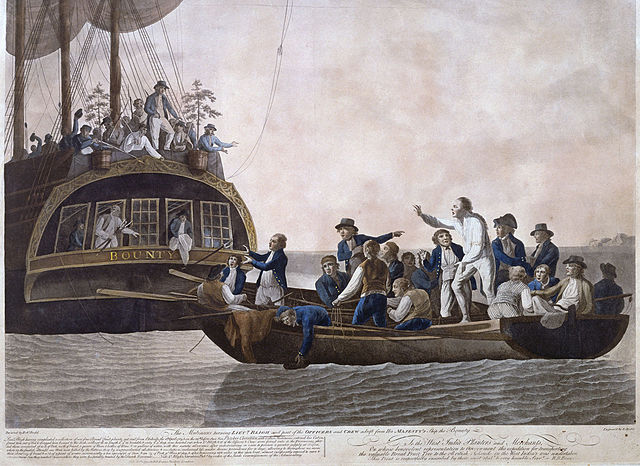
But there is much, much more to the man. Just a few of his achievements are: President of the Royal Society for an unequalled 42 years; co-founder of the (what is now called the) Royal Horticultural Society and the African Association that sent out Mungo Park to search for the source of the River Niger; agricultural pioneer; the man who arranged the theft from Portugual of Merino sheep and thus secured their into the British flock; the founding father of scientific plant hunting; pioneer of ensuring scientific studies were included as a core component to voyages of discovery (Vancouver, Flinders and Scorsbey to name but three); and driving force behind the establishment of the Ordnance Survey mapping of Britain. And of course he was the organiser of the voyage of economic plant transfer that ended with the Mutiny on the Bounty. 

Photo Credit https://upload.wikimedia.org/wikipedia/commons/thumb/5/50/Mutiny_HMS_Bounty.jpg/640px-Mutiny_HMS_Bounty.jpg

At his London home, 32 Soho Square, Banks established what may be described as his own private research institute which housed his collections of specimens (now held by the Natural History Museum - the link gives a good summary of Banks and his work) and what was then the greatest natural history library in Europe (now in the British Library). Here he welcomed in scientists from across Europe, irrespective if whether the two countries were at war, and corresponded globally. 


So I welcome you to dive into The Multifarious Mr. Banks and discover that while Sir Joseph had no single scientific discovery on which to hang his reputation, he was not only a fascinating character but also instrumental in forging history in a number of ways, the repercussions of which are still felt today.

Friday, 11 March 2016

Meet Thomas Ruddy, the blogging Victorian head gardener.

Its the stuff novels are written about - inheriting a trunk and opening it to discover it filled with a treasure trove of documents that tell fascinating story. 


In this case the treasure is a collection of journals written by Thomas Ruddy (1842-1912) who was head gardener at Palé Hall in North Wales. The journals are not day-to-day accounts of gardening but rather a record of a remarkable life.


And thanks to the hard labours of their current owner Thomas' life and works are being published on his fascinating eponymously-named blog. This truly is a remarkable record, not only because of its contents but perhaps more so because of the paucity of surviving accounts written by head gardeners.


With a big thank you to Wendy who has done so much hard work to make Thomas' accounts available to all of us, do visit Thomas' blog and immerse yourself in his fascinating yet lost world.

Thursday, 25 February 2016

Heirloom Plants...

...so called in the USA and Australia, or as we in Britain call them...Heritage Plants.  A few years back I wrote a book entitled Heirloom Fruits and Vegetables (in the US) and Heritage Fruits and Vegetables (in the UK) which explored the stories behind our popular fruits and vegetables and offered examples of  old-fashioned cultivars that remain available to grow.

A fascinating book to research and write, but with one frustration - there was insufficient space detail as many of those splendid surviving cultivars as I would have liked.
 
Click For More Info
Thankfully ‘Thomas Etty’ (in the guise of his great, great grandson Ray Warner who like his illustrious ancestor is also a seed merchant) has come to the rescue with Heirloom Plants.
 
 
Based on the seed catalogues of Thomas Etty (the company) - click here for their website - and arranged by vegetables, fruits, herbs and flowers and looking most Victorian, this illustrious tome is a directory that offers the reader names and descriptions of a wide range of heritage / heirloom cultivars which we SHOULD ALL BE GROWING in our gardens. The book concludes with short section of Cultivation Tips and a very helpful ‘Seed Suppliers & Useful Organisations check-list.

There are many good and justified reasons why we gardeners should grow these wonderful old-fashioned cultivars and now there is no excuse.
 

Thursday, 10 September 2015

Hidden Gardens & Urban Oasis

Vegetable Garden of Monastery of Santa Croce in Gerusalemme, Rome. Photo credit
Not a specifically garden history post this time but rather a plea for help with a project I am working on. That is to identify the world's best small urban gardens - the quirkier and more unusual the better. 

The main criteria are that the gardens must be a) hidden gems, that is to say so not well known about - although well know suggestions such as New York's Payley Park are most welcome. And b) the gardens must be open to the public - with or without an entrance fee.

Fay Park, photo credit.
The gardens can be historic or contemporary, for example Fay Park in San Fransisco - a rare example of a Thomas Church garden, or the delightful Wendy's Secret Garden in Sydney whose future is under threat.

Wendy's Secret Garden. Photo credit: Time Out
If you can help out with any suggestions, please do email me. I have also started a Pinterest page.

Thank you!

Wednesday, 9 September 2015

Garden Restoration at the Museum in the Park, Stroud

Photo credit: Kites over Stroud

According to the Stroud News construction work begins to open up ‘hidden’ garden behind the Museum in the Park. The restoration of this walled garden is not only to return the garden to its original quadripartite form and to develop the four quarters, but also to open the garden up to the community and offer new learning and public programming opportunities.

The project is being run by the  the Friends of the Museum in the Park and there is more information here on how to become involved and support this worthy project.

Tuesday, 8 September 2015

Bishop's Palace gardens, Abergwili

 
Photo Credit: Trip Advisor
Another garden restoration to report on, this time in Wales. The neglected grounds of the Bishop's Palace in Abergwili, Carmarthenshire are going to receive a whopping £1.2 million facelift, according to the Camarthen Journal.  

The gardens surround the Palace which is home to the Camarthenshire Museum, and the Welsh Historic Gardens Trust (WHGT) which is leading the project  has  secured funding to commission specialist reports to explore ways in which the grounds may be rescued and revitalised.

Following this there will be a further grant application to secure the funds to enable the physical work which will, according to Judith Holland of WHGT "conserve and revitalise the Bishop's Park, the walled kitchen garden and portions of the great meadow and the Bishop's pond." 

Lets keep our fingers crossed that the funding comes through!

Victorian Garden Restoration at Woodchester Mansion

Photo Credit: Western Daily Press
Another cheering garden restoration story, this time form the Western Daily Press reporting on the most unusual property of Woodchester Mansion in Gloucestershire.

Woodchester Mansion is a 19th century Gothic masterpiece hidden in a secluded Cotswold valley and which was mysteriously abandoned mid-construction in 1873. National Trust staff and volunteers discovered the remains of the Italianate terraced garden overgrown with trees. Very little is known about it, although documents dating from 1843 record terrace walks, a temple overlooking the view of the garden below, and ornamental fountains.

More visitor information can be found from the National Trust webpage.

Thursday, 3 September 2015

Paradise Gardens...

...is officially published today by Frances Lincoln.  I am very excited. 

There is  a review of it by Alison Levey on her The Blackberry Garden blog.
 

Conferences & Symposium


A quick heads-up for a handful of conferences and symposium to put in the diary. A number also have a call for papers. 


The fourth international meeting of the European Architectural History Network will be held in Dublin, Ireland, on 2-4 June 2016. The deadline for submission of papers is 30 September - more here.


The VI International Conference on Landscape and Urban Horticulture is to be held in Athens, Greece between 20-25 June 2016.  Organised by the Laboratory of Floriculture & Landscape Architecture of the Agricultural University of Athens, under the auspices of the International Society for Horticultural Science is now open for Abstract Submission.


Environment and History is looking to build on the success of its sponsored 'Parks and Gardens' panels at the European Society for Environmental History this summer in Versailles by putting together a special issue of the journal focused on park and garden history. Applications are invited for papers from scholars working in any field whose work interrogates the subject of parks and gardens with a historical emphasis.


Last but not least, Garden and Landscape Studies at Dumbarton Oaks invites proposals for presentations at the 2016 symposium “Landscape and the Academy.”  Universities are custodians of some of the world's most significant designed landscapes. How and why have they come to be responsible for so many different kinds of landscapes? And what role do these landscapes play today in academic life, pedagogy, and cultural politics? To be considered for inclusion, send a c.v. and a one paragraph to one page abstract to landscape@doaks.org by September 15, 2015.

Saturday, 29 August 2015

Restoration of Quex Park Walled Garden

Photo Credit: Quex Park
The garden team at Quex Park in Kent is planning to restore the Victorian Walled Garden to its former glory. But as is so often the case in such situations there is shortage of records from which to work.

So the team is sending out a plea for help. They are looking for photographs of the walled garden before the hurricane in 1987, memories from anyone who worked in the gardens and information or pictures relating to the garden between 1883 and 1923.

If you can help, please contact the team here, and for more on this story read the article in the Isle of Thanet Gazette.

Friday, 28 August 2015

Hooray for 'Capability' Brown

Blenheim Palace (from 1764)  is often considered Brown's finest work
Next year marks the 300th anniversary of the birth of Britain's greatest landscape designer, Lancelot 'Capability' Brown. Certainly his work was the apogee of the eighteenth-century English landscape garden, and I still maintain that if one applies the two Modernist maxims of 'Form follows Function' and 'Less is More' then Brow was not only the first Modernist landscape designer but also by far the most successful.

However in the 232 years since his death poor old Brown has come in mor more than his fair share of stick. In fact vitriol would be a more accurate word. A destroyer of formal gardens, a displacer of villagers are but two of the accusations used to beat him with.

And to our national shame Brown has been deliberately ignored or exorcised from various celebrations of British gardening and garden history. So thank goodness that he is now getting some of the much credit he is due.

Portrait of Lancelot ‘Capability’ Brown, c.1770-75,
Cosway, Richard (1742-1821)/Private Collection/Bridgeman Images.
Today sees the launch of the 'face' of the Capability Brown Festival 2016 . The portrait of the affable-looking chap himself is by Richard Cosway, probably between 1770 and 1775. 

The Festival has been has been funded by a £911,100 grant from the Heritage Lottery Fund with the wider project worth in the region of £1.7million. Much of this represents match funding, and funding in kind, from the Festival’s partners and supporters. 

The website has a wholæe host of information about events, projects etc., etc, and here too you can sign up for the latest news.

There are more than 250 sites associated with Brown across England, with a small handful in Wales. They range from small private gardens to larger country estates, and include 12 public parks, some schools and hotels. Many are managed by members of the Historic Houses Association, the National Trust, and English Heritage. 

To find an example of Brown's visionary genius near you, check out this interactive map.

New Facebook Page


Just to say I have decided to join the 21st century and now have a Facebook page. Nothing up there just yet except a mugshot, but do drop by and 'Like' if you so feel inclined.

Thursday, 27 August 2015

Unlocking the Swiss Garden at Shuttleworth in Bedfordshire

Photo Credit: Andy Marshall
Welcome to a Guest Post from Garden Manager Corinne Price who shares a year in the life of this rare Regency gem:

I can’t believe it’s over a year since the completion of the Swiss Garden restoration project.  It was a mammoth 18 month task, hampered by bad weather and the odd technical hiccup, but we got there, and we proudly re-opened the garden to the public in July 2014.

During the £3.6m restoration, the garden’s delicate 13 listed buildings and structures – including 6 listed at Grade II* - underwent careful, specialist conservation.  Traditional materials and techniques were used where possible. 
Our two-storey centrepiece, the Swiss Cottage, was re-thatched using water reed from Norfolk, its finials re-gilded with 23 carat gold leaf and the missing or broken rustic decoration replaced.  Conservationists were able to recreate the original decoration by cleverly slicing Monterey pine cones and hazel and willow twigs.  

Altogether, over 25,600 shrubs and 8,400 bulbs were planted in 53 beds by horticultural contractors.  We laid 340 metres of path, using 300 tons of gravel and reinstated the lost Regency vistas to reveal the  ‘stage set’ views of the buildings, bridges, urns, arches and other garden features as originally intended in the early 19th century by the garden’s creator, Lord Ongley.

We also added a striking sculpture trail through the woodland, created by chain-saw sculptor Patrick Brown and inspired by ideas suggested by children from seven local schools, based on the garden and its history.    

Swiss Garden Today
With the hectic initial restoration behind us, the focus for the garden team has now shifted to returning more of the plants which had been lost from the garden after years of neglect. Craftsman Gardener, Kevin Hilditch, local apprentices Luke Lademan and Aaron Saralli and a growing band of volunteers now maintain the Swiss Garden.     

Photo Credit: Andy Marshall
The stunning Grade II* listed Grotto & Fernery had 4,300 panes of glass replaced with hand-cut, handmade cyclinder glass during the restoration and its interior has now been replanted with plants. In the Pulhamite-lined tunnels installed by the Swiss Garden’s Victorian owner, a selection of ferns which can deal with the lack of light have been popped into the planting pockets and are already beginning to thrive.  They include Adiantum, Asplenium, Dryopteris, Polypodium and Polystichum as base planting, with added interest in the form of different frond shapes - for instance ‘Hart’s Tongue’ ferns, the parsley-like Athyrium felix-femina 'Lady in lace’ and Cyrtomium fortunei  with its sickle-shaped pinnae.  Also included are some of the smaller varieties of hostas.

Photo Credit: Darren Harbar
The tunnels open into the Regency conservatory area – which is much lighter, brighter and warmer.  Here we were able to add more colour and four large Strelitzia reginae, bought as mature plants and already flowering, act as a vibrant centrepiece.  The strong architectural form of this plant contrasts beautifully with the more delicate fronds of the tree ferns and the addition of Streptocarpus and further light-tolerant ferns add more variety to the mix.   Wisteria sinensis, which was previously trained along wires to arch across these beautifully glazed ‘arms’ of the Grotto & Fernery, have also been replaced.

Outside, the garden now boasts more ferns and ground cover plants in the steep banks leading down to the Grotto & Fernery.  The ground-cover plants are helping us with the maintenance of this challenging area – it is dry, very steep and difficult to weed!  A base planting of hardy staples such as Geranium, Digitalis, Brunnera and Alchemilla has been embellished with splashes of Vinca, Viola odorata and Omphalodes cappadocia.   Bulbs also play an important part.  We aimed for a fairly naturalistic planting style, with plenty of fern material to connect this area to the Grotto & Fernery while also providing a functional and dense ‘mulch’ of ground cover plants to assist with the retention of moisture and to curtail weed growth.

Elsewhere in the garden, the Floral, Pond Cascade and Chapel Arches now host a selection of newly planted rambling rose and Clematis varieties, and future plans include the addition of a series of ‘intense horticultural moments’ into the garden’s main series of planted beds, to break up the shrub planting and offer further colour and vibrancy. 

Restoration of the 9-acre Swiss Garden has transported it back to its Regency appearance, when its creator, Lord Robert Henley Ongley dropped his ‘alpine’ landscape, complete with tumbling water and grassy slopes into its unlikely, previously flat, Bedfordshire setting.  With its buildings rescued from decay and its meandering paths, water features and vistas looking very much as they once did, the past year has seen us build on this structure by adding the finishing touches in the form of the plants which soften its lovely features and once again make it the magical place it once was.    
   
‘Quaint’, ‘quirky’, ‘hidden gem’ and 'fairyland' - words and phrases that may seem a bit clichéd, but as the most complete surviving example of a Regency garden in Britain, we think Swiss Garden justifies them all!  One thing is for certain - at the Swiss Garden, you will discover a little oasis of charm and tranquillity which, along with our three resident peacocks, makes for a memorable visit.

The Swiss Garden  is located at The Shuttleworth Collection (Old Warden) Aerodrome, Near Biggleswade SG18 9EP. Open from 9.30am to 5pm daily.  Admission to Swiss Garden is £8 for adults and £7 for seniors with children under 16 free.  Joint tickets, to include entry to the Shuttleworth Collection are £20 for adults and £17.50 for seniors. 
The Swiss Garden also hosts events – click here for more information 

The Shuttleworth Collection has almost 50 aircraft on display dating from 1909 and vintage cars and stages regular air displays and other events and click on the link for for the full programme of events at Shuttleworth

Wednesday, 26 August 2015

Paradise Gardens - my new book


Plants and gardens have been, and in many cases continue to be, cornerstones of religions. Plants imbued with symbolism and gardens created as an earthly expression of a paradisaical afterlife. 

Think about it - the Tree of Knowledge of Good and Evil with its 'apple' (I know, the garden in Eden is supposed to have been a real place on Earth not an afterlife concept), the chahar bagh form of the Islamic garden, all those great Ancient Greek myths, the Epic of Gilgamesh, the lotus in Buddhism and the Island of the Blessed in Taoist mythology, etc., etc., etc.

So, my splendid new tome, Paradise Gardens is the story of plants and gardens within seventeen different global religions over a five millennia time frame. And, even though I say it myself it is a fascinating story. Moreover many of the religio-garden forms have been and are still an inspiration for secular gardens the world over.  

For some more information about the book, check out its Amazon page....


Back to School Offer


As you likely know I teach a couple of online courses at My Garden School. One entitled Garden History, the other Heritage / Heirloom Fruits and Vegetables.

Now that its back to school time, there is 15% discount offer on these  - and all courses run by My Garden School.

Just click on this link to take advantage - offer runs until end of October.

And I'll very much look forward to meeting you in the virtual classroom.

Tuesday, 11 March 2014

Landscape and Green Spaces Conference


Just a quick heads-up of a forthcoming Conference held by the Centre for West Midlands History Landscape and Green Spaces and entitled ‘Garden History in the West Midlands’.

The Conference runs over Saturday 29 March, is being held at the University of Birmingham.  The aim, to explore the garden history of the West Midlands.

More information and booking details can be found here

Friday, 7 February 2014

Joseph Hooker Videos


Just to follow up on my last post concerning Sir Joseph Hooker and the fact Kew has made his correspondence available online, there are also some excellent movie clips about this remarkable man available online also.

Made by Jupe Productions and Peter Donaldson there are eight great short films to watch:


Enjoy!

The Joseph Hooker Correspondence Project


Another great result from Royal Botanic Garden, Kew where a team have been digitising and now make available online the Correspondence of Sir Joseph Hooker.  Hooker was true Victorian polymath who succeeded his father as the second Director of Kew, who was Charles Darwin's confidant, and who also plant hunted in Sikkim (and elsewhere).

This truly is a magnificent resource for garden and plant historians and botanists alike so do take a look at the website as it also has a whole lot more about the man and his work than just his letters.

There is even an article I wrote for Kew Magazine describing an expedition I made a few years back to north Sikkim to follow in Hooker's footsteps - a truly wonderful trip.  Scroll to the bottom of the page and there you can also download the article and read it at your leisure. 


Hooker had it on the nail when, in a letter to his father, he described the valley sides ablaze with Rhododendron flowers thus: 'The Mt sides here actually bloom white, scarlet, purple, pink, yellow no language can exaggerate their beauty.'