Showing posts with label william kent. Show all posts

Friday, 7 September 2012

Claremont Landscape and House open this Weekend

Claremont Landscape showing the Amphitheater
Both the historic landscape gardens of Claremont (National Trust) and the Claremont Mansion (Claremont Fan Court School) are open this Sunday 8 September for 'Heritage Weekend'.  

The history of the estate begins with Sir John Vanbrugh who in 1708 built himself a small house and began work on  the gardens.  In 1714 Vanbrugh sold the house to the wealthy Whig politician Thomas Pelham-Holles, Earl of Clare, who later became Duke of Newcastle and served twice as Prime Minister. The Earl commissioned Vanbrugh to add two great wings to the house and to build a fortress-like turret on an adjoining knoll. From this so-called 'prospect-house', or Belvedere, he and his guests could admire the views of the Surrey countryside as they took refreshments and played hazard, a popular dice game.
Work on the gardens began around 1715, and by 1727 they were described as ‘the noblest of any in Europe’. Within the grounds, overlooking the lake, is an unusual turfed amphitheatre.  Today they are especially important as an early example of the English Landscape Garden and contain elements by the all the great landscapists - Charles Bridgeman, William Kent and subsequently 'Capability' Brown

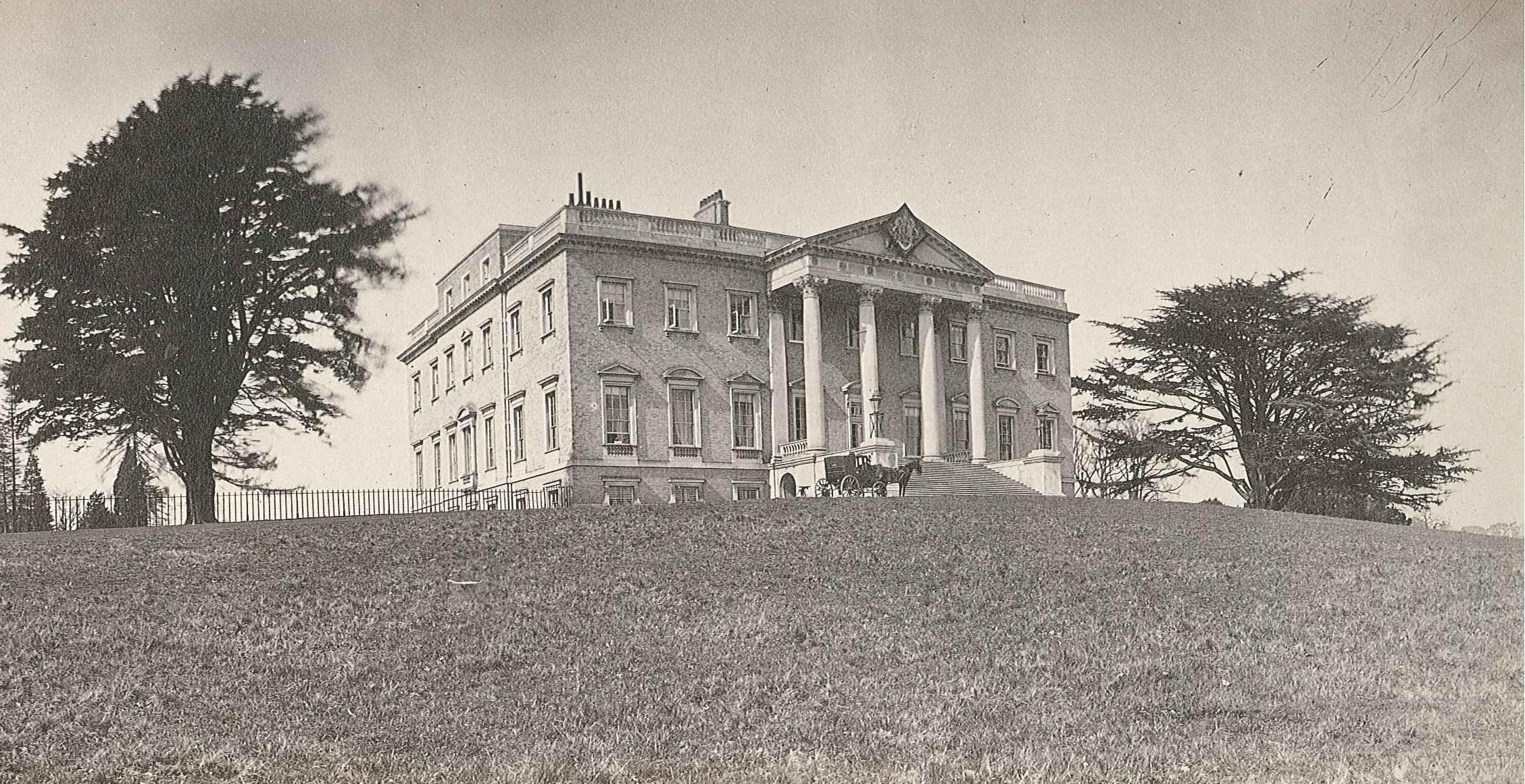
Claremont Mansion in c.1860
 In 1768 Newcastle's widow sold the estate to the super-wealth Robert Clive, Baron Clive of Plassy, who is is said spent £100,000 (about £10,400,000 today) on his new mansion and the grounds.  Clive's Palladian mansion is an interesting example of 'Capability' Brown's work as an architect.  Subsequently it was occupied by Princess Charlotte (daughter of George IV) upon her marriage to Leopold of Saxe-Coburg.   It was also favourite of the young Queen Victoria, who celebrated many of her birthdays here.  In  the aftermath of the 1848 Revolution Victoria offered the mansion as a refuge to the French King Louis-Philippe and his Queen Marie-Amelie.

The gardens are open from 10am to 6pm, the mansion from 11am to 5pm with guided tours at 11.30am and 3pm

Monday, 16 April 2012

Thursday, 8 March 2012

F is for Ferme Ornée

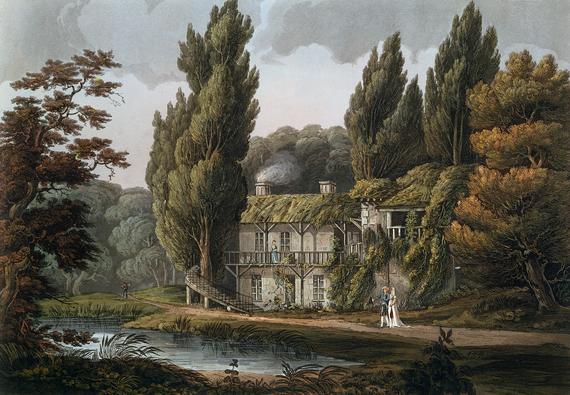
Le Petit Hameau of Marie-Antoinette at Versailles
The ferme ornée or ornamental farm was a phrase coined by Stephen Switzer who described it thus in his  Ichnographia rustica or The Nobleman, Gentleman and Gardener's Recreation (1715): 'By mixing the useful and profitable parts of Gard'ning with the Pleasurable in the Interior Parts of my Designs and Paddocks, obscure enclosures, etc. in the outward, My Designs are thereby vastly enlarg'd and both Profit and Pleasure may be agreeably mix'd together'. Thomas Whateley provides an extended description in his  Observations on modern gardening  (1770).  

Both books is downloadable free (via the links) thanks of our friends at the Biodiversity Heritage Library.

However it took a few years for this ‘alternative’ landscape style to catch on and the original ferme ornée  was made by Philip Southcote. In 1732 Southcote, then 35, married the Dowager Duchess of Cleveland, a woman almost twice his age, and the couple moved to Woburn (or Wooburn) Farm near Weybridge in Surrey. Because of his Catholic faith he was denied a career in politics or position at at court and so he set himself to landscaping.  

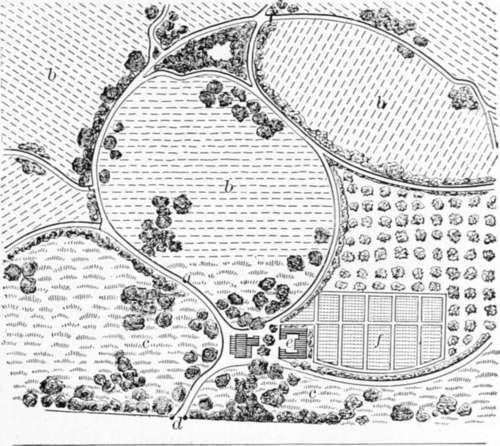
Plan for a ferme ornée from Landscape Gardening by Andrew Jackson Downing
Rather than acres of sculpted topography, swathes of sward, ornamental clumps of trees and shelterbelts, classical buildings and lakes, Southcote developed the ferme ornée with its pictorial and bucolic scenes.  A carefully contrived amalgam of a working farm, flowery walks, and architcecturally-ornamented farm buildings. 

An ornamented farm building
At Woburn several buildings were of these designed by Southcote's friend, the landscape designer, William Kent about whom I have already posted.

The main element of the design was its serpentine walk which took the guest on a circuit of the landscape. The five foot wide sand path was flanked on either side by a hedgerow that was enriched with a wide range of trees, and a border of shrubs, climbers, and herbaceous species, chosen with particularly emphasis on scent; and arranged by height from smallest in the front to tallest at the back. 
The Path Planting at Woburn (R W King)
This floral path was carefully threaded through the farmland in a way that presented the bucolic scenery as a succession of pictorial scenes - carefully contrived gaps in the hedgerow framing the desired views and vistas.  The artistic impact was made all the more scenic by ornamenting the farmland.  For example, buildings such as barns were given crenelated facades, the banks of the excavated serpentine river were carefully mounded, the grass sward was embellished with small groups of shrubs and beds of flowers, and movement and sound were provided by the cattle, sheep, and wildfowl.  The ferme ornée never became a big fashion, but  was popular amongst a select cognoscente.

Sadly no ferme ornée survive, but as well as at Woburn, examples were made at The Leasowes in Halesowen by William Shenstone; Riching Park (later Percy Lodge) in Buckinghamshire; Apps Court in Surrey, Mickleton in Gloucestershire; White Knights in Berkshire (now the campus of the University of Reading) and Enville in Staffordshire.

Thursday, 1 March 2012

E is for English Landscape Garden

Brown's landscape at Longleat - more natural than nature
Many thousands of acres of downland Britain that we assume are ‘natural’ were, in fact, parts of carefully designed English landscape gardens created in the 18th and early 19th centuries.  The move away from the formal, French-inspired garden of the late 17th century towards a reappraisal of Nature was stimulated by the Grand Tour, innovative farming techniques, and Enclosure. 

Charles Bridgeman
The first ‘landscapist’ was Charles Bridgeman (d.1738), and his greatest contribution was the introduction of the sunken hedge or ‘ha-ha’.  

A ha-ha
This brought the broader landscape into the garden, which evolved not just as something to look at, but also to look through.  

William Kent
The pace of change was maintained by William Kent (1684-1748) - the subject of an earlier post - who further de-formalised the garden and created idealised, picturesque landscapes - works of art inspirited by the Classics and set within a tamed, sculptured Nature. 

Venus Vale at Rousham
However, it was the much-maligned Lancelot ‘Capability’ Brown (1716-83) who created what has been described as Britain’s greatest contribution to world art. 

Lancelot 'Capability' Brown
His landscapes were wholly English in their character and inspiration, and Sir Horace Walpole perfectly encapsulated Brown’s work: ‘Such was the effect of his genius that when he was the happiest man he will be least remembered, so closely did he copy nature that his works will be mistaken.’  

Blenheim Palace
I also argue that if you apply the maxim ‘form follows function’ Brown was the original Minimalist Modernist - a work of art composed of water, grass, trees and topography that simultaneously turned in a profit as a productive landscape.

Humphry Repton
Brown’s successor was Humphry Repton (1752-1818), who I call 'Practicality' Repton because he combined beauty with utility primarily by reintroducing the terrace, but as Industrial Revolution suburbia rose and gardening for the masses arrived, formality returned to the garden....

Sheringham Hall
If you want to experience these works of art here are some suggestions of gardens to visit.  There is no unadulterated Bridgeman garden extant, although Claremont in Surrey and Chiswick House in London retains elements. The latter was designed in co-operation with Kent with whom Bridgeman worked on several projects

The finest example of Kent’s work is Rousham in Oxfordshire.  Brown’s crowning glory is Blenheim Palace, also in Oxfordshire: and Repton’s ‘darling child’ is Sheringham Hall in Norfolk.

This is a link to a feature on Georgian Gardens.

Wednesday, 22 February 2012

D is for Druids Cave

Queen Caroline's Hermitage at Richmond Lodge
Bit of an odd one for today's garden feature. But that's such a part of the fun of garden history - all the weird and wonderful that happened in our gardens, and the reasons why it happened.

During the 18th century and as a part of the movement towards the new, naturalistic English Landscape style there was considerable revival in antiquarian interests.  There was a re-rediscovery of the Classics - literature, architecture and archaeology.  However, this interest in things ancient was not restricted to Italy and Greece, and there was a lively curiosity with the early history of Britain and its inhabitants.  One area of particular fascination was the mysteries of the druids.

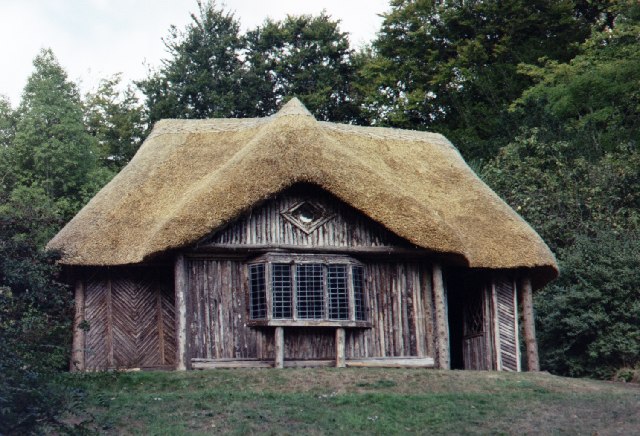
Originally called the Hermit's Hut, Killerton's  Bear Hut was erected in 1808.  Attribution: David Smith
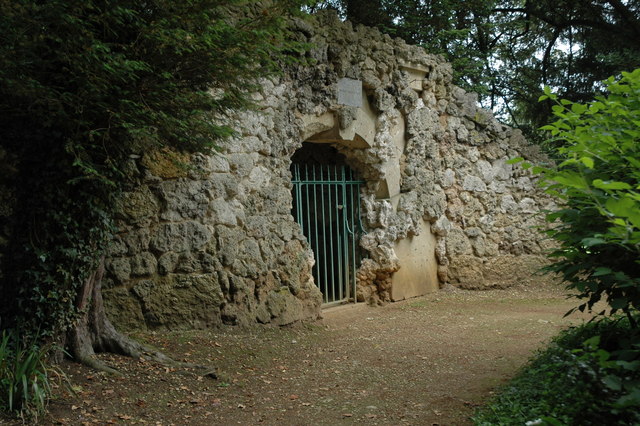
As with many of the Classical rediscoveries which were played out in the new landscapes, in the form of picturesque natural scenery, emotional overtones and garden buildings, so too the interest in druids took physical form.  Many new gardens created from the 1720s onwards were embellished with a druid’s cell or cave, a term often also given to a rustic structure or hermitage.  

Dido's Cave at Stowe, a 'classisised' Druid's Cave. Attribution: Philip Halling Smith
Built from stone or wood - the use of tree stumps and roots was popular, although Classical embellishments were also used, it was important that the druid’s cell or hermitage was inhabited by a hermit or druid.  In most instances models made of waxworks, straw stuffed clothes, or clockwork sufficed, but occasionally a ‘live-in’ hermit was employed.  For example by the Duke of Beaufort at Badminton in Gloucestershire - click here for image of the hermitage.  Here, the hermit’s role was to live alone, to appear bedraggled, and to terrify visitors.  However, Beaufort fired his hermit for enjoying female company and for moonlighting on other nearby estates. 

The Stowe Hermitage by William Kent, 1731
Stowe also has a hermitage but the building is in classical style.  Here too, the resident hermit was sacked - this time for drunkenness.

Friday, 30 December 2011

William Kent, The Picturesque Landscape & Rousham

The English Landscape Garden is arguably one of Britain’s greatest contributions to world art.  And while many garden lovers have heard of Lancelot ‘Capability’ Brown’ (1716-83) not so many are familiar with his predecessors such as William Kent (c.1685-1748).


Put simply, Kent designed idealised landscapes with softened edges, sinuous walks, water features, many varied buildings and long prospects where garden and park were indistinguishable.  As Horace Walpole put it, Kent ‘leaped the fence, and saw that all nature was a garden.’

Yet the scenes Kent created were not English but took their inspiration from Italy, from the romantic images of classical times.  These landscapes were designed to be a picture, a work of art laden with emotional overtones of tranquillity, gaiety, grandeur and melancholy, all set within a tamed, sculptured Nature. 

The noted garden historian, Professor Tim Mowl offers an insight onto Kent and his work on this video of his 2010 Claremont Garden History Lecture.  Here is part one (of seven):


However, it is not easy to visit a Kentian landscape because his works were overlaid by successive incarnations of the English landscape garden.  Most often by ‘Capability’ Brown.


A most notable exception is Rousham in Oxfordshire.  


Admittedly the landscape has suffered the ravages of time and lack of cash, yet it fully retains both its layout and emotional harmonics - and oftentimes you find you are the sole visitor!
 

For those who wish to read more, try Simon Pugh’s ‘Rousham and the English landscape garden’.

And for comparison, Blenheim Palace, perhaps the finest example of ‘Capability’ Brown’s landscaping work is a mere 7 km from Rousham.