Thursday, 8 March 2012

F is for Ferme Ornée

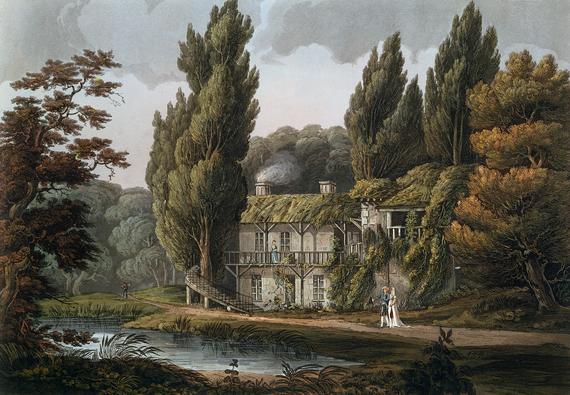
Le Petit Hameau of Marie-Antoinette at Versailles
The ferme ornée or ornamental farm was a phrase coined by Stephen Switzer who described it thus in his  Ichnographia rustica or The Nobleman, Gentleman and Gardener's Recreation (1715): 'By mixing the useful and profitable parts of Gard'ning with the Pleasurable in the Interior Parts of my Designs and Paddocks, obscure enclosures, etc. in the outward, My Designs are thereby vastly enlarg'd and both Profit and Pleasure may be agreeably mix'd together'. Thomas Whateley provides an extended description in his  Observations on modern gardening  (1770).  

Both books is downloadable free (via the links) thanks of our friends at the Biodiversity Heritage Library.

However it took a few years for this ‘alternative’ landscape style to catch on and the original ferme ornée  was made by Philip Southcote. In 1732 Southcote, then 35, married the Dowager Duchess of Cleveland, a woman almost twice his age, and the couple moved to Woburn (or Wooburn) Farm near Weybridge in Surrey. Because of his Catholic faith he was denied a career in politics or position at at court and so he set himself to landscaping.  
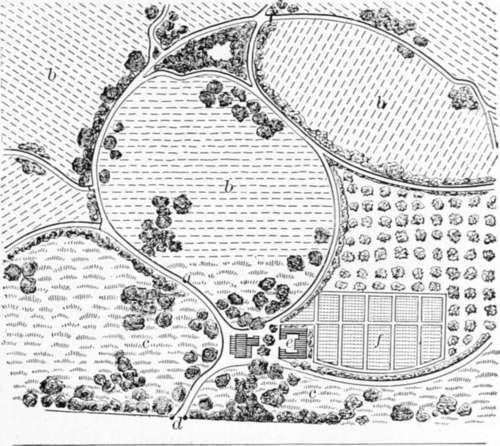
Plan for a ferme ornée from Landscape Gardening by Andrew Jackson Downing
Rather than acres of sculpted topography, swathes of sward, ornamental clumps of trees and shelterbelts, classical buildings and lakes, Southcote developed the ferme ornée with its pictorial and bucolic scenes.  A carefully contrived amalgam of a working farm, flowery walks, and architcecturally-ornamented farm buildings. 

An ornamented farm building
At Woburn several buildings were of these designed by Southcote's friend, the landscape designer, William Kent about whom I have already posted.

The main element of the design was its serpentine walk which took the guest on a circuit of the landscape. The five foot wide sand path was flanked on either side by a hedgerow that was enriched with a wide range of trees, and a border of shrubs, climbers, and herbaceous species, chosen with particularly emphasis on scent; and arranged by height from smallest in the front to tallest at the back. 
The Path Planting at Woburn (R W King)
This floral path was carefully threaded through the farmland in a way that presented the bucolic scenery as a succession of pictorial scenes - carefully contrived gaps in the hedgerow framing the desired views and vistas.  The artistic impact was made all the more scenic by ornamenting the farmland.  For example, buildings such as barns were given crenelated facades, the banks of the excavated serpentine river were carefully mounded, the grass sward was embellished with small groups of shrubs and beds of flowers, and movement and sound were provided by the cattle, sheep, and wildfowl.  The ferme ornée never became a big fashion, but  was popular amongst a select cognoscente.

Sadly no ferme ornée survive, but as well as at Woburn, examples were made at The Leasowes in Halesowen by William Shenstone; Riching Park (later Percy Lodge) in Buckinghamshire; Apps Court in Surrey, Mickleton in Gloucestershire; White Knights in Berkshire (now the campus of the University of Reading) and Enville in Staffordshire.

Tuesday, 6 March 2012

Jahanara - another lost Mughal garden


In 1648 the fifth Mughal emperor Shah Jahan (famous for building the Taj Mahal - which is now in danger of collapse) moved into his new capital, Shahjahanabad.  Now known as Delhi, it had taken 11 years to build and now replaced Agra as the capitall of the Mughal empire.

According to an excellent article in the Deccan Herald, Jahan's two daughters  'Jahanara and Roshanara, the two princesses, laid out gardens, market squares and serais (rest houses) which were among the most beautiful creations within the new walled city. It was Jahanara, Shah Jahan’s favourite daughter on whom he had conferred the title of Begum Sahib, who had laid out Chandni Chowk, the main market square, and the garden known as Begum ka Bagh.'

The latter, was well recorded by historians and accounts describe the enclosed garden, into which only women and children were allowed, as having 'pools and channels for running water. There were fountains and canopies supported on 12 pillars of red stone (called bara dari). These provided cool resting places for the people who came to the garden. The water in the channels came from a special canal system and helped irrigate the trees and grass and plants within. There were plenty of flowering trees and fruit trees'

Not much peace and tranquility today (image Deccan Herald)
Begum ka Bagh remained a garden for  royal ladies until the reign of Shah Alam II before becoming Company Bagh early during India's rule by the British East India Company. In 1876 it was renamed again to the Queen's Garden following Queen Victoria's elevation to Empress of India.  Sadly, the Begum Samro's Palace which was built in the garden during the reign of Shah Alam II is now one of the main markets for electrical goods in Delhi and of the gardens, the only surviving part is now the Mahatma Gandhi Park.

Oruawharo - a Garden Restoration in New Zealand

Images from the Oruawharo website
In central Hawke's Bay on the North Island of New Zealand's stands Oruawharo.  According to Oruawharo website, the house which was completed in 1879 was designed by a Wellington architect and built by D McLeoud of Waipukurau at a cost of some £4000 for Sydney Johnston and his bride Sophia Lambert. And surrounding the house were 17 hectares, (40 acres) of gardens and parkland laid out by Johnston who replicated the landscapes he had seen around stately English homes, and who as a keen tree-lover, planted thousands of trees.


In 2000 Peter and Dianne Harris purchased Oruawharo, which was suffering from 30 years of neglect.  As well as bringing the house back to life Peter and Dianne have embarked on a restoration of the grounds with the aim of returning them to their early splendour.  Cleared of undergrowth the hillside woodland once again reveals numerous fine trees specimens while nearer the house the croquet lawn is once more smooth and verdant and surrounded by gardens.  In the fields opposite is the large vegetable garden next to which are new additions - citrus and olive groves, a vineyard and oaks and hazelnuts for a truffiere.

Monday, 5 March 2012

'Yes' for Aberdeen's City Garden Project

Image from Aberdeen Garden Cite Project website.

This controversial scheme, in which voters were offered the choice between retaining the historic gardens or opting for the £140m City Garden Project redevelopment, has passed in favour of the latter.  With a 52% turnout the result was 45,301 'yes' and 41,175 'no',  a  majority of 4,126.

The 'yes' will mean that historic Union Terrace Gardens will be lost as part of the redevelopment.  For both sides of the argument, here are the websites of the Aberdeen Garden City Project  and the Friends of Union Terrace Gardens.

Hannah Carter Japanese Garden - Update.

Image from Save the Hannah Carter Japanese Garden
Back in January I posted about the threat to the Hannah Carter Japanese Garden in Los Angeles.  Sadly, the University of California is proceeding with its decision to sell the garden.  In response a coalition of interested groups and individuals - Save the Hannah Carter Japanese Garden - has been formed with the intent and aim of preserving the garden.

Please do visit their website - there is also a downloadable factsheet on this page - and see if there is any way in which you can help save this historic garden.

Friday, 2 March 2012

Views of Versailles by Alexandre Benois

King's Walk - really?

Here is a nice post for a Friday from another garden history blog - gardenhistorygirl.  Hope you enjoy her great post Views of Versailles by Alexandre Benois

Thursday, 1 March 2012

E is for English Landscape Garden

Brown's landscape at Longleat - more natural than nature
Many thousands of acres of downland Britain that we assume are ‘natural’ were, in fact, parts of carefully designed English landscape gardens created in the 18th and early 19th centuries.  The move away from the formal, French-inspired garden of the late 17th century towards a reappraisal of Nature was stimulated by the Grand Tour, innovative farming techniques, and Enclosure. 

Charles Bridgeman
The first ‘landscapist’ was Charles Bridgeman (d.1738), and his greatest contribution was the introduction of the sunken hedge or ‘ha-ha’.  

A ha-ha
This brought the broader landscape into the garden, which evolved not just as something to look at, but also to look through.  

William Kent
The pace of change was maintained by William Kent (1684-1748) - the subject of an earlier post - who further de-formalised the garden and created idealised, picturesque landscapes - works of art inspirited by the Classics and set within a tamed, sculptured Nature. 

Venus Vale at Rousham
However, it was the much-maligned Lancelot ‘Capability’ Brown (1716-83) who created what has been described as Britain’s greatest contribution to world art. 

Lancelot 'Capability' Brown
His landscapes were wholly English in their character and inspiration, and Sir Horace Walpole perfectly encapsulated Brown’s work: ‘Such was the effect of his genius that when he was the happiest man he will be least remembered, so closely did he copy nature that his works will be mistaken.’  

Blenheim Palace
I also argue that if you apply the maxim ‘form follows function’ Brown was the original Minimalist Modernist - a work of art composed of water, grass, trees and topography that simultaneously turned in a profit as a productive landscape.

Humphry Repton
Brown’s successor was Humphry Repton (1752-1818), who I call 'Practicality' Repton because he combined beauty with utility primarily by reintroducing the terrace, but as Industrial Revolution suburbia rose and gardening for the masses arrived, formality returned to the garden....

Sheringham Hall
If you want to experience these works of art here are some suggestions of gardens to visit.  There is no unadulterated Bridgeman garden extant, although Claremont in Surrey and Chiswick House in London retains elements. The latter was designed in co-operation with Kent with whom Bridgeman worked on several projects

The finest example of Kent’s work is Rousham in Oxfordshire.  Brown’s crowning glory is Blenheim Palace, also in Oxfordshire: and Repton’s ‘darling child’ is Sheringham Hall in Norfolk.

This is a link to a feature on Georgian Gardens.